

Event report: EFCEM General Assembly, Lisbon, Portugal
On 16-17 June 2026, EFCEM held its annual General Assembly meeting in Lisbon, Portugal. Secretary general Joakim Granfors provides an update from the event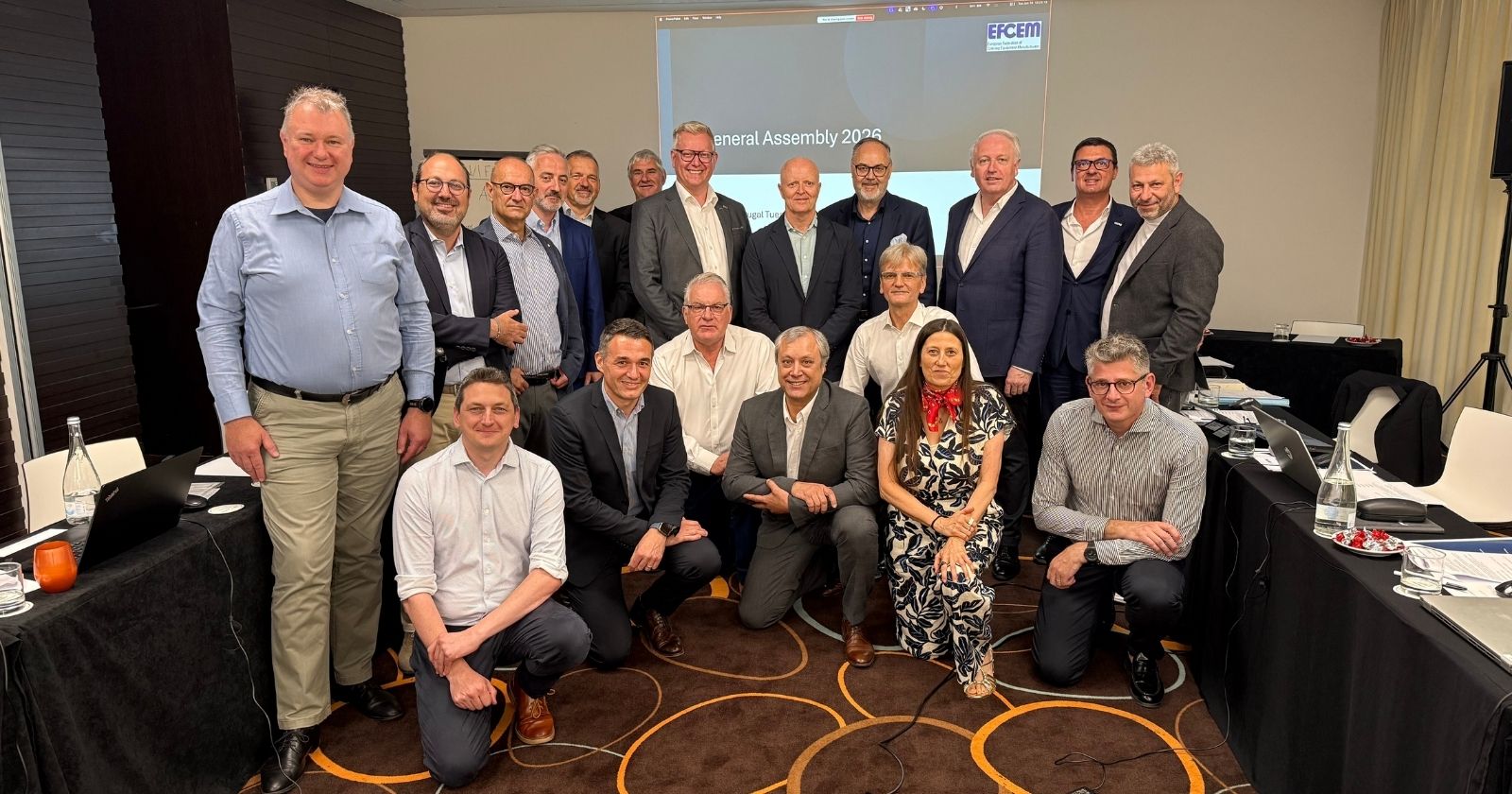
EFCEM's 2026 General Assembly, was held this year in Lisbon, Portugal, on 16-17 June 2026. It saw members, including new president-elect Alfredo Oliveira of APIRAC (Portugal), and current president Martin Ubl (who will remain on the EFCEM management board as past president later this year), attend to discuss the Federation's considerable progress, and its future.
One key focus was for the individual EFCEM Working Groups (WGs) to feed back on their latest learnings, which we collate here:
WG1 – BIM/IFSEBIM (interim convenor: Fabian Anzmann of HKI)
The secretary general presented on behalf of the convenor, describing WG1 BIM as one of EFCEM's “most productive groups”. The IFSEBIM data dictionary – an EFCEM/FCSI/NAFEM partnership since 2012 – provides a free, standardized parameter set with several hundred parameters for catering equipment. Meanwhile, new versions of the Parameter Data Dictionary and the "Revit Guideline for Food Service Equipment Content Creation" are now published. A BIM survey confirmed limited stakeholder awareness, while FEA reported a clear shift among UK specifiers towards requesting IFSEBIM data, underlining the need for National Associations of Producers (NAPs) to drive adoption. Detailed info and guidelines can be found on https://www.ifsebim.org/. Last meeting was on 19 March 2026; next WG1 meeting is on 3 November 2026.
WG2 – Environment (convenor: Sascha Deisel of HKI)
WG2 (which last met on 26 March 2026) covered ecodesign under the ESPR 2025–2030 plan (mid-term review 2028), the Digital Product Passport (DPP) and its draft registry implementing act, the professional dishwashers ecodesign stakeholder meeting (online, 23 June 2026), CBAM, and the F-gas exemption expiring 30 June 2026. EFCEM's EU Ecodesign Forum application is in preparation. On CBAM, the definitive phase began in January 2026 (upstream materials such as steel and aluminium), and the Commission has proposed extending it downstream to finished goods, with potential relevance for catering equipment. At the EU stakeholder meeting on professional dishwashers on 23 June, in which EFCEM participated, new information on the EU ESPR work on commercial dishwashers was presented; in light of this, WG2 set up an EFCEM WG2 Task Force on Commercial Dishwashers to coordinate input on ecodesign requirements based on the current ESPR drafts and, among other proposals in those drafts, to monitor how they address compliance information for commercial dishwashers through either a Digital Product Passport or EPREL, a point which remains unclear at this stage. Next WG2 meeting is on 10 November 2026.
WG3 – Health, Safety & Water (convenor: Mattia Merlini, EFCEM Italia)
WG3 (which last met on 24 February 2026) focused on the Drinking Water Directive (DWD), Food Contact Materials (FCM) and PFAS. Two DWD deadlines apply: products newly placed on the market must comply with the ECHA positive list from December 2026; existing nationally certified products have until December 2032. The DWD/FCM boundary is agreed as "the tap". On PFAS, RAC adopted its final opinion on 2 March 2026 and SEAC's final opinion is expected by the end of 2026; the restriction proposal covers more than 10,000 PFAS substances. The very broad scope affects non-stick coatings, seals, O-rings, expansion valves and refrigeration components, with strong F-gas interaction. WG3 stresses no overlap with existing legislation, that "technically feasible" is not practically applicable, and the need for adequate derogations and transition periods. Next WG3 meeting is on 10 November 2026.
WG4 – Connectivity (interim convenor: Joakim Granfors)
Following the 2025 split from WG1, WG4 (which held its first meeting in May 2026), with NAFEM and FCSI participating, reviewed the Cyber Resilience Act (in preparation), the EU Data Act (in force; SME exemptions apply but do not apply to subsidiaries of larger groups, so group companies within large groups remain in scope; an Orgalim guide was circulated), and the AI Act / Digital Omnibus, where Orgalim, through its strong EU-level advocacy, is working to ensure that AI in regulated machinery remains governed by the Machinery Regulation in order to avoid dual regulatory obligations. The SG highlighted OPC UA (companion specification 30200) as a major, publicly available taxonomy and communication standard for commercial-kitchen machine data (underpinned by more than 47 million OPC UA devices installed globally). NAFEM is progressively aligning its NDP protocol with OPC UA 30200, and FEA reported that manufacturers are already beginning to adopt OPC UA 30200 over proprietary languages. Next WG4 meeting is on 25 November 2026.
WG5 – Marketing
EFCEM marketing activity is being rescaled for Q3/Q4 2026 in line with an agreed budget, with priority on General Assembly communications and Working Group visibility.
NAP-EFCEM liaison officer – WG Master Directory oversight
During the General Assembly, EFCEM also highlighted a positive new step to strengthen coordination with the National Associations, by proposing dedicated liaison contacts in each country to help keep working group participation aligned and well structured.
In its ongoing collaboration with the NAP, EFCEM outlined a plan for each NAP to appoint a liaison contact person to support the WGs communication framework and membership alignment. This approach underlines EFCEM's commitment to transparent, well-managed information flow and to ensuring that participation in its expert groups is firmly anchored in active national membership, thereby reinforcing the value and credibility of EFCEM's pan-European information exchange.
NAP members mapping – roles and product coverage
EFCEM is building a robust picture of the real industrial weight behind its National Associations by mapping members' roles and product coverage across Europe. This collective dataset is becoming a key asset to demonstrate EFCEM's representative strength towards EU institutions and stakeholders.
Through a structured NAP membership mapping exercise, EFCEM and its National Associations are consolidating information on the types of companies they represent, with a particular focus on catering equipment manufacturers and related businesses. By progressively refining definitions and, in future, potentially adding indicators such as employment and turnover, this common database will help quantify the economic footprint of the sector.
This will reinforce EFCEM's voice in Brussels, and ensure that policy discussions reflect the full scale and diversity of its membership base.
Orgalim Convention 2026: a roundup
The secretary general also summarized the Orgalim Convention, noting Orgalim's role as EFCEM's Brussels policy gateway (competitiveness, electrification, power costs, advanced manufacturing) and EFCEM's 20+ year membership, whereby value is extracted mainly through active working-group participation. HKI raised the recurring conflation of domestic versus commercial/professional appliances in standardization – a risk for sustainability files (repairability, material efficiency, DPP) – and urged EFCEM to assert the distinction at Orgalim level and in all communications.
Economic outlook roundtable among NAP members
Members also shared aggregated national outlooks (which is voluntary, under the EFCEM Code of Conduct). Common themes emerged: high energy and food costs; pressure on casual-dining/independents; a strong service and spare-parts market; robust consultant pipelines; a shortage of chefs and technicians; and growth in chains, coffee shops and tourism. Here are some additional insights:
- UK (FEA): inflation ~3%; hospitality (pubs, casual dining) under pressure; low single-digit growth forecast; service and spare parts strong; consultant pipeline busy.
- Germany (HKI): market down up to 3% (combi-steamers, coffee machines); high labor/restaurant prices; Chinese pressure in coffee machines; care sector resilient; no subsidies.
- France (SYNETAM): ~3% growth expected next quarter; rising raw-material/transport costs squeeze margins; growth in snacking, coffee shops and bakeries; energy regulation driving efficiency.
- Sweden (BFS): slow recovery; restaurant bankruptcies releasing second-hand equipment; chef shortage; growth in elderly-care/institutional kitchens; September election a key risk.
- Italy (EFCEM Italia): sector +3% in 2025, exports up; 2026 softer (US tariffs on exports); strong tourism and employment; high energy costs; low wages; "Industry 4.0" boosting connected appliances.
- Portugal (APIRAC): GDP ~2%, tourism-driven; only ~2.5% of members are EFCEM-scope manufacturers (mostly installers/distributors); ~5,000 technicians needed; EPBD pending; DWD to concern.
- Spain (FELAC): 2025 turnover +2.5%; 2026 stable ~2%; cost pressure on plastics and aluminium; growth in coffee shops, supermarket dining and chains; tourism strong (~97m).
- Greece (SEEME): more stable economy; manufacturing growing with flexible SMEs; tourist-driven inflation; large hotel projects for 2027–2028 but weaker small-restaurant demand.
NAP story: IFSA Ireland – 60 years of excellence
Anthony Cooney of IFSA presented IFSA's history: founded in 1965 as the Catering Equipment Association, and renamed the Irish Food Service Alliance in 2012 as Irish manufacturing declined, it now represents equipment distributors and consumable/food wholesalers across the island of Ireland. IFSA owns the Catex exhibition, held in Dublin every second year (the next edition of which is in February 2027) and runs Chef Network (4,500 chefs, events and a tech conference. The SG proposed featuring NAP stories at future meetings.
Keynote – Catering equipment power and energy reduction: Dr Sam Mudie FCSI
UK consultant Dr Sam Mudie FCSI of Hospitality Energy Saving & Sustainability delivered the keynote address. Drawing on a decade of sub-metered data, she estimated UK commercial catering energy cost at roughly £35bn/year (~8% of the UK carbon footprint, comparable to data centres).
Mudie demonstrated electrification business cases (often near cost-neutral once ventilation, cleaning and insurance co-benefits are counted) and power-optimization tools for grid-constrained sites.
With no UK public funding for equipment replacement (confirmed by HKI and FEA), the stronger lever is “carbon reduction rather than subsidies”, with scope to cooperate on energy-efficiency data and interoperable communication.
Joakim Granfors
Secretary General
EFCEM